To update you on the situation of Emfesz (the Hungarian gas provider and frequently remarked upon company) and the murky world of its operations in Hungary, I would suggest you check out this post on the Jamestown Foundation's website. The deal involves a $1.00 transfer of the company in Switzerland, $1 billion fraud and notably famous Russians like Alexander Medvedev and the Kremlin PR machine. While the story itself is noteworthy of underworld business dealings, and whether correct or not I don't know, but the results appear to be that Gazprom now holds a 20% share in the retail gas market in Hungary.
This later point is particularly important and needs a few remarks. If we go on the assumption that at least some parts of this story are true, then that would mean that at least people in Russia know where Hungary is and that very important people in Russia are interested in Hungary. Ok, a basic premises, but something that is important to establish before going foreword. My second point is that this lends credibility to the idea that there is a concerted effort by the Russian government and Russian companies to involve themselves in the downstream business affairs of the Hungarian retail market.
And why is this important to establish and hasn't it been obvious in the past? You may remark. The point is that while Russia and Russian associates bumble around and leave bread crumb trails to track their moves, if a concerted strategy can be detected from multiple events then we can begin to talk of a concerted Russian strategy to control downstream retail assets of energy companies.
The detection of a concerted Russian state and private strategy is important because then we are not relying solely on rumors of who owns Surgutneft (SNG's attempt to take over MOL) for example. Therefore if Gazprom, or some company closely associated with it, owns Emfesz now with 20% of the Hungarian gas market, then dramatic inroads have been in Hungary's newly opened competitive gas market. And competitive it may be, Gazprom's entrance into the UK market resulted in competition occurring and customers switching. We'll have to wait to see what the prices will be on offer. This should be shown in the near furture. In the more distant future is the ownership stakes Russian oil and gas companies will have in Hungary and whether they are taken over through similar tactics.
Tuesday, July 14, 2009
Emfesz and the Spider's web


Thursday, June 4, 2009
Visions of the (Western) European Energy Future
So if Russia turned off all the gas taps to Europe, Europe would be fine, since other alternatives are possible - unless you are Bulgaria. Well, that was the viewpoint of one leading (Western European) academic of at the 6th European Energy Market Conference in Leuven, Belgium. I attended it last week (May 27-29, 2009).
To keep you in suspense and to keep you reading, I'll come back to the gas presentation, after I run through the contents of the conference and how actual alternative energy systems are very much part of the future, which also challenges the assumption of Europe, and let's not us forget Eastern Europe's ability to withstand a cutoff of Russian gas.
But I have to offer one disclaimer, in my notes I did not write the speakers name. I'll put this down having an awful cold during the conference, and even now I'm coughing up a lung. When the presentations are sent out hopefully they'll shed some more light.
One of the first speakers at the conference described the building of an intelligent network and distribution system which includes communication technologies relying on broadband internet and software forming it into a multilayered and interdependent system. He established the energy industry as the 21st century source of innovation infused with novelty and breakthroughs. On this point, all were in agreement, but thinking back on it, there were still limited examples of the actual application of these novel solutions. While we are only 9 years into the 21st century one can still hope that we will enter into it sooner rather than later. The fact, told at the conference, that much of Europe's energy infrastructure needs to be replaced, due to it's age, in the next 10 to 20 years offer this opportunity for re-engineering the transmission network. Maybe in it's replacement we see these smart concepts and a 21st century grid built.
The regulatory issues and Europe's third energy package were also discussed. Probably the best description of this debate is there is emerging a bidirectional flow of energy, information and money. And as we know the proper implementation of regulation can aid and foster this bidirectional flow.
The greater coordination of regulation and infrastructure building also offers opportunities to balance out reasonable prices, with security of supply concerns and the environment, as explained by one speaker from Electrabel. Importantly, as expressed by ETSO, the investments that occur today need to be informed by scenarios beyond 2020. Scenerios that include smart cars and smart grids. But as I will note below, does this include the cutting off of gas from Russia?
Regional markets and their importance and the importance of a regional regulator were espoused. I love it all and it is spot on. The solutions lie in regional cooperation with practical solutions such as 'social transmission charges' for communities not directly benefiting from transmission lines. I guess this could be labled as 'local blackmail' or 'political opportunitism', but from a geographical point of view, it can be called 'locational advantage'.
Cool word: fugitive emissions
Best useful factual thought: oil volitility depends on past volitility, natural gas volitility responds to unanticipated events such as supply interruptions or reduced stock.
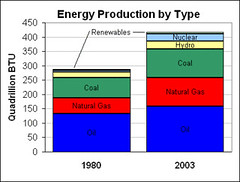
Now we arrive to the Friday afternoon session on the European gas market. Or rather the geopolitics of gas. And yet another important quote speaks from my notes, "natural gas may become the fuel of consequence because of the delays in building enough renewable energy sources and implimentation of CCS technology." And despite predictions, gas demand won't drop until at least 2020, because of the failure to diversify now. Due to the low CO2 from gas and the ability to build gas generation quickly it can fill this technological gap.
Diversification was spoken of. Diversification from the Ukraine, through Nabucco and LNG. The consideration was there of mutual dependency of Russia and Europe on Russian gas supply. I think it needs to be examined, just like the concept of 'mutual destruction', was considered, how 'mutual gas dependency' influences the political and economic activiities of Europe, Russia and the US. Does this ursurp mutual destruction?
However, at the same time it is seen that cross-border flows, mainly within Europe's interconnectors, are key to the continents long term security of supply. But national protection needs to be avoided. Strategic gas storage is unsound and should be avoided - it is for the short term and does nothing for the long term security of supply.
So now we come back to the point about Russian gas. Easily for the next 10 to 20 years we have increasing demand for gas while the 21st energy system is being developed and deployed to a limited extent by 2030. To satisfy this increase in demand for gas, the solution will come from building more LNG facilities and gas pipelines from Russia and central Asia. However, even if planned LNG terminals are built in Poland and Croatia and interconnector capacity is increased, by design, there will still be a large dependency on Russian gas. As pointed out by a speaker, if the failure to build adequate renewable energy sources and a technological hurddle exists for CCS, then gas will become an increasing part of the electricity mix with new capacity meeting this new demand, thereby not displacing Russian gas. Thus reliance on Russian gas and all the geo-economic-politics that goes along with it should not be seen as diminishing in the foreseeable future, nor the effects of turning off the taps. Energy independence and security of supply are boosted when external threats to supply disruptions, with consideration of cost, are reduced to a small percentage. It remains to be seen whether Russia will be a reliable supplier to Europe once alternatives to Ukrainian transit are removed.
Wednesday, May 6, 2009
The Rebirth of Middlemen for Russian Gas

You would think - well, depending how long you thought for - that you could just go to Gazprom and buy the gas that you needed. I mean, who else sells gas in the quantities that a domestic supplier needs in CEE? PGNiG is pursuing this strategy by agreeing to buy gas from Gazprom according to newsreports:
May 4, 2009
Rzeczpospolita, 29 Apr 2009, online:- Polish newspaper Rzeczpospolita has found out that the Polish national oil and gas concern PGNiG, which estimates its gas supply shortage at 2.5 billion cubic metres, is not going to accept the gas supply offer of the Hungarian Emfesh (sic), as it prefers to buy gas directly from a producer rather than from an intermediary.
The brief article goes on to say that PGNiG is in talks and early agreement with Gazprom. But we'll have to wait and see what entity the deal is inked with. BECAUSE, it is interesting to note that a) Emfesz was even bidding to supply gas to PGNiG and b) that Emfesz just announced that it would be buying gas from RosGas AG. According to Emfesz and this analysis by Roman Kupchinsky in his posting from the Jamestown Foundation, RosGas AG actualy belongs to the owners of Emfesz and Gazprom. However, this connection to Gazprom has been denied by Gazprom, as Kupchinsky explains and disputes.
At this point, there are a lot of loose ends and I'm not sure how to draw a conclusion about this. I can only say that it is interesting that Emfesz was bidding to supply Poland with gas when it would obviously be buying gas from Gazprom, and possibly through RosGas, which could supply the contract. We'll have to wait and see which entity PGNiG signs the contract with. Either way, the demise of RUE does not signal the end of murkey ownership and supply structure when it comes to Russian gas. Kupchinsky explains the establishment of RosGas as reward for one of Emfesz's owner for loyalty. I think there are other ways, even for Russians, to reward loyalty, we'll have to wait and see how other factors in Hungary, particularly with Russia's new interest in MOL play out. Loyalty is most effective when you are working together over the long term.

 Posts


